


It is one of the greatest paradoxes of human nature that man can be both selfish and altruistic. Altruism or prosocial behavior or kindness is innate in humans. Human affection has its roots in parental care, a template, physiological and hormonal system it allows people to be caring, cooperative and kind.
But, of course, human kindness is selective. We tend to help those who can help our genes the most. First, we tend to help ourselves the most because we are 100% our own genes. Then, we are kind to ourselves genetic relatives and our spouse, can give us more genetic relatives (children). The closer we are, the kinder we are. After that we help our relatives. Finally, we are kind to the friends we build relationships with.
Of course, some friends may be closer to you than some relatives, but this is a general trend. It’s rare to be kind to a stranger who can give you nothing in return, so it’s seen as heroic and elicits a “wow” reaction from onlookers. But people never do anything that can’t benefit themselves or their genes.
Related: The psychology of self-sacrifice
Goodness is dangerous
Kindness can be defined as behaving in a way that costs you but benefits another. It makes sense, but it’s not that simple, because there’s usually a benefit for you, but it’s delayed. It is common for people to expect future benefits for their present kindness. We look forward to building relationships with people who can help.
Also, kindness feels good and increases our well-being. These benefits can offset the costs of kindness. If kindness did not have these privileges, it would not have developed.
Despite these potential benefits, kindness puts you at risk.
- What if what you help doesn’t help you later?
- What if they take advantage of you by repeatedly asking for favors with little or nothing in return?
Why is it considered a weakness?
1. The weak are taken advantage of
Strong people are able to defend themselves and are unlikely to use them. Those who are exploited by others are seen as weak, unable to defend themselves. They have less power. The strong have more power. The strong can defend themselves because they can be aggressive.
And the weak cannot be aggressive. If aggression is associated with strength, then its lack is associated with weakness.
Humans are a power-conscious species, and they are well aware of how much power they have over others. The situation is about power. Weak, exploitable people are seen as low-status, more power-hungry, dark triad personalities. People feel a natural hatred towards those who are exploited.
This is why so many negative things are said about the victim and how they could do better than criticizing the actions of the abuser/exploiter. A culture of blaming the victim is widespread. The assumption is that if you are strong, you should never be exploited.
2. Action of force by the receiver
When you make someone feel powerless, they are motivated to take the power back. When you help someone, you create giver-receiver dynamic. The giver is stronger than the taker. As a giver, you may genuinely want to help the recipient, but there’s no denying the sense of power or even superiority you feel. If you feel superior to someone, then the other person is inferior. It’s natural for them to feel inferior and powerless, even if it’s not your intention. Even if they don’t admit it.
So the recipient, upset by the loss of this power, may attack your kindness. They may question your true intentions and call your kindness fake. They might even call it weak. They are just trying to put themselves back in a stronger position.
This explains why people fight over who pays. No one wants to be the recipient. Not only because they do not want to burden others, but also because they are in a weak and powerless state. This may be a simple solution to a common problem:
“I’ll pay today. You can pay next time.”
It works every time because it prevents the giver-receiver dynamic from forming. Both are givers, both are receivers. Give and take cancel each other out. No one has power, no one loses it. The same goes for anyone healthy relationships. In general, give and take cancel each other out. No one gives more or takes more.
3. Shadow projection
Our shadow is a set of personality traits, usually negative, that we refuse to face. Say you’re selfish, but deny it. When you meet someone who is generous and kind, you are reminded of your selfishness. What they are reminds you of what you are not. You will notice a significant difference between how they are and how you are. It is called contrast effect in cognitive psychology.
At this point, it’s easier to attack who you are than to look at your shadow. You reject or criticize their kindness, calling it fake or weak. Their kindness clashed with who you were. We tend to put our identity at risk.
3. Feminine behavior
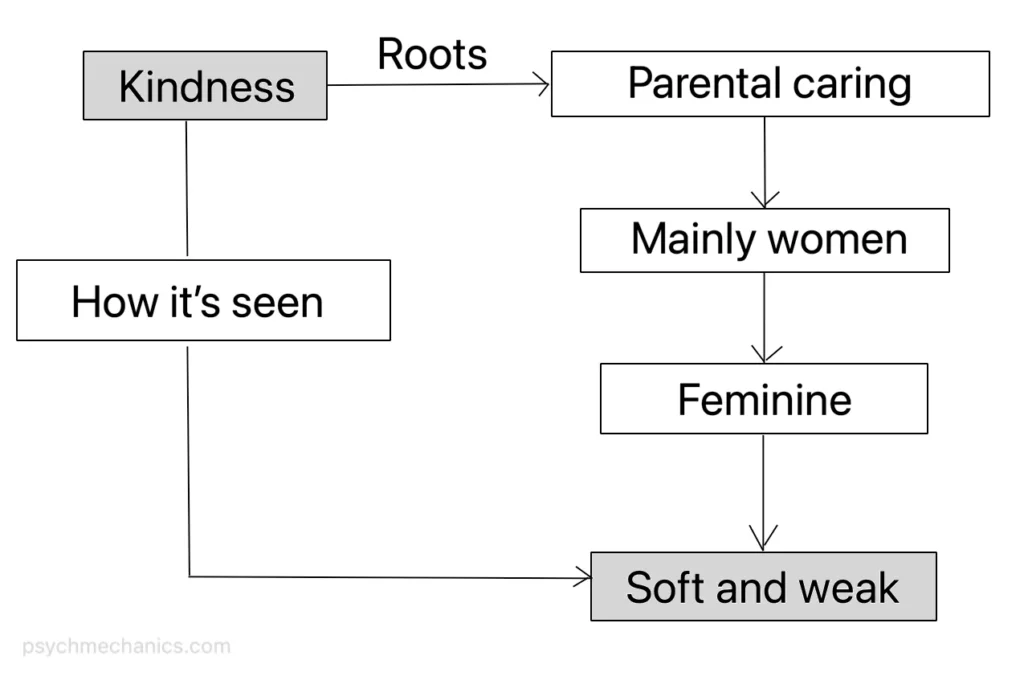
Male kindness is more often perceived as weakness. The reason for this becomes clear when you look at it through an evolutionary lens.
Since men compete for the status of a dominance hierarchythey are expected to be dominant and rise to higher levels of the hierarchy. Thus, they increase their value in the dating market and in society. Climbing up the hierarchy and being the provider is seen as masculine behavior.
And women play a major role in raising and caring for the offspring. I said above that human kindness comes from parental care. Thus, kindness, care, and concern are seen as feminine behaviors. Femininity is associated with softness and vulnerability. So, if a person is kind and caring, he looks soft and weak.
4. People like it
Kindness is hard to separate from people-pleasing. The behavior is the same. The difference is in the motives. Two people may perform the same behavior but for different reasons. If people-pleasing fosters kindness rather than helpfulness, it is considered weak.
It seems weak because you want to use kindness as a tool please othersapproval and acceptance and reputation building. If you want to be seen as a good person, it comes from a flaw; a place not to be a good person. If you know you’re a good person, you don’t have to prove it. Shows. You have to be yourself. Your kindness is a quality that distinguishes contexts and situations, which shows that you are not trying to get something out of your kindness.
And people see it. They see you trying to prove that you are a kind person and they hate it. As one study states:
“Social actors are castigated as pompous braggarts, empty virtue signalers, or holier-than-thou hypocrites.”
People-pleasing has roots fawn trauma response. This is:
- A desperate attempt for validation and acceptance
- Boundless kindness and perseverance
- Say “Yes” to every request
- Self-renunciation
Being kind should feel good. When it doesn't, it's likely self-abandonment. It's disempowering and you can almost feel power leaking from your body.
True kindness is a choice. This is:
- Desire to build relationships
- The desire to build trust and goodwill
- Kindness with boundaries and persistence
- Say “No” when necessary
- Kindness without self-denial
I disagree with the definition of 'true kindness' as kindness that does not expect anything back. Reciprocity is at the core of human nature.
Being ruthless
If you are kind and use it, it is easy to go from good to bad, from submissive to aggressive:
“From now on I won’t be nice. I’ll show them.”
This is a natural defense mechanism, a self-defense tactic. You want to avoid taking profits in the future. Instead of “passing”, I suggest you try to be persistent. This is the middle ground between passivity and aggression. You will remain kind, but you will not allow others to take advantage of you.
If you refuse to be kind, you go against your nature. You would be missing out on the social and welfare benefits of kindness. Of course, it is not a good idea to be kind to everyone blindly. Instead, show your kind side to people who appreciate it. Selective kindness doesn’t mean you’re horrible to people outside of your “circle of kindness.” This means that you should be careful who you are kind to, because kindness is dangerous.
If you see yourself as a kind person, then being cruel lowers your self-esteem. Choosing to “be mean” because kindness is seen as weakness is a betrayal of who you are and who you want to be. Being bad because being good is seen as weak is a form of slavery because your self-worth depends on how others see you. Who cares how it’s “seen”? If you want to be like that, be like that.


